
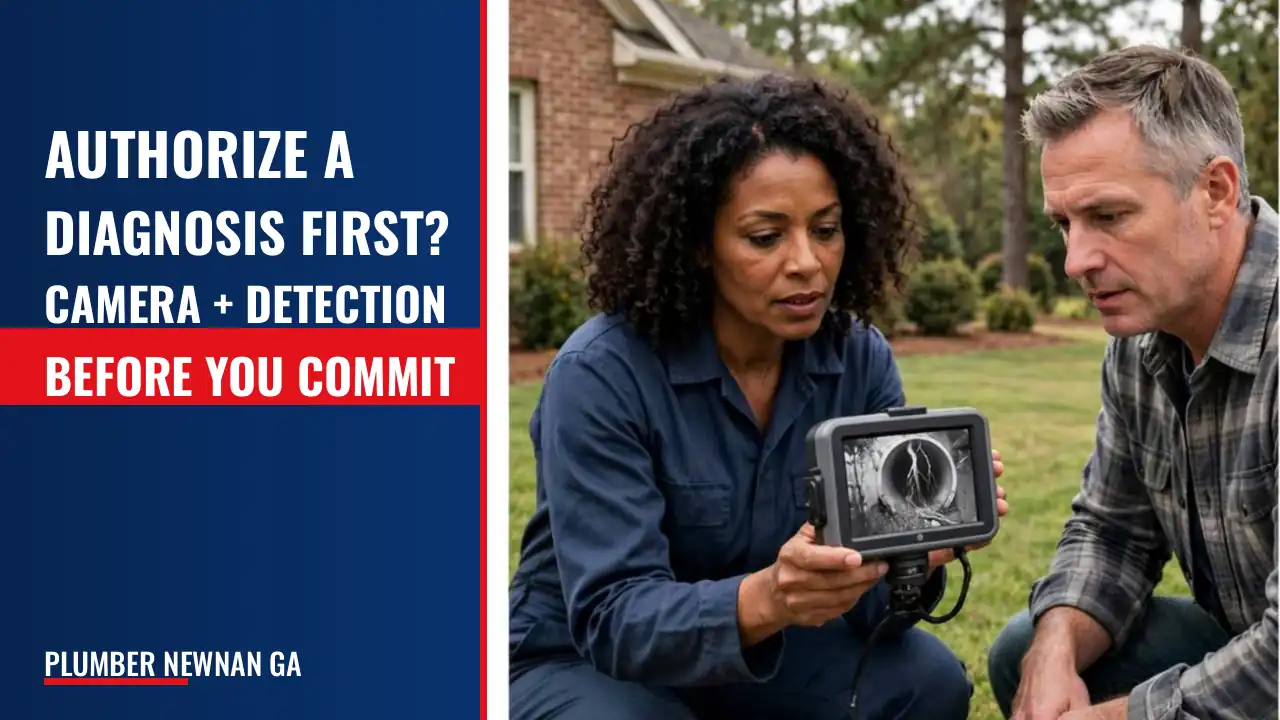
Should You Authorize Diagnosis Before Committing to a Repair Scope?
Yes, authorize diagnosis first in almost every case where the cause is not already visible. A camera inspection or leak detection costs far less than a repair aimed at the wrong problem, and it turns a guess into evidence you can review before any repair scope is agreed.
The exception is a failure you can see and name yourself, like a dripping faucet or a toilet that will not stop running.
What Does Authorizing Diagnosis Actually Mean?
Authorizing diagnosis means paying a plumber to find the cause of a problem and document it, before you agree to any repair work or its price. The deliverable is evidence: camera footage of the inside of a drain or sewer line, a leak-detection report showing where water is escaping, or a pressure test result. You are buying information, not labor, as our blog explains.
Diagnosis is separate from repair because plumbing problems hide. A water leak under a slab shows up as a warm spot or a high bill, not as a puddle at the source. A cracked sewer pipe shows up as a slow drain three rooms away. Without diagnosis, a repair scope is a list of guesses, and you pay for the guesses that turn out wrong.
A camera inspection is a flexible camera pushed through a drain or sewer line to record its condition. Leak detection uses acoustic listening, pressure isolation, or thermal tools to locate water escaping from a pipe without opening walls or floors. Both produce a record you keep, and both fall under our plumbing maintenance services.
How Does the Diagnostic Process Work?
The process runs in a fixed order: isolate the symptom, test the likely causes, record the finding, then scope the repair from that finding. Skipping the recording step is what turns diagnosis into an opinion.
1. The plumber interviews you about when the symptom appears and what changed recently. 2. They isolate sections of the system, shutting valves or plugging drains to see which part holds pressure. 3. They run the specific tool for the suspected cause, such as a camera in a sewer line or an acoustic sensor on a slab leak. 4. They show you the footage or readings and explain what the evidence supports. 5. Only then does a repair scope get written.
The evidence matters because it is what a second opinion can check. Ask for the camera recording, the leak-detection readings, or the pressure test numbers. A plumber who cannot produce them has not finished diagnosing, whatever they tell you.
When Is Diagnosis Worth Paying For?
Diagnosis is worth paying for whenever the cause is hidden, the repair is expensive, or more than one repair could plausibly fix the symptom. Those three conditions cover most sewer, slab, and underground pipe problems.
Hidden causes are the clearest case. A water leak inside a wall or under a slab cannot be scoped by looking. Leak detection finds the source so the repair opens one patch of wall or floor instead of several. The same logic applies to a slow drain: a camera inspection tells you whether the blockage is grease near the trap or a collapsed pipe thirty feet out, and those are very different repairs.
Expensive repairs justify diagnosis on cost alone. Replacing a sewer line or repiping a house is a major spend, and a camera inspection that rules out the worst case can save you from paying for work you did not need. Diagnosis also protects you when a repair has already failed once, because it explains why, so contact us when it needs a professional.
When Can You Skip Diagnosis?
You can skip diagnosis when the fault is visible, isolated to one fixture, and the repair is small and predictable. A faucet that drips at the spout, a toilet that runs, or a supply line leaking at a visible joint are all cases where the cause is in front of you.
Diagnosis also adds little when a previous inspection is recent and still accurate. If a camera inspection recorded a specific crack last month and nothing has changed, re-running it before the repair mostly repeats known information. Say so, and ask whether the earlier footage can scope the work.
The judgment call is a symptom that could be minor or serious. A single slow drain might be hair in the trap or a root intrusion in the main line. If the drain has backed up more than once, or more than one fixture drains slowly, treat it as hidden until a camera says otherwise.
What Should You Ask Before You Authorize It?
Ask what the diagnosis will produce, what it covers, and what happens to that cost if you proceed with the repair. A clear answer to those three questions tells you whether you are buying evidence or paying for a visit.
Ask which tools will be used and whether you receive the output. Camera footage and leak-detection readings are the record you keep, and they are what lets you compare a second opinion fairly. Ask whether the diagnosis covers the whole suspected system or only one section, because a partial inspection can miss the real cause.
Ask what the repair scope will look like if the diagnosis finds nothing. Some symptoms, like a high water bill with no visible leak, can take more than one pass to pin down. Knowing that in advance stops the second visit from feeling like a surprise. For a closer look at how the tools produce evidence, see how a plumber diagnoses a leak, clog, or failed system.
What Should You Not Do?
Do not authorize a repair scope that names a cause nobody has demonstrated. A scope that says "replace the main line" without footage or a test result is a guess with a price attached.
Do not open walls, floors, or a slab to look for a leak yourself. Cutting into a slab or a finished wall to find water risks structural damage and usually finds the wrong spot, because water travels along the path of least resistance. Leak detection exists to avoid exactly that.
Do not approve the cheapest diagnosis without checking what it includes. A camera pushed partway down a drain and pulled back is not the same as a recorded inspection of the full run. Ask what the tool will actually see before you agree.
Diagnosis becomes a job for a licensed professional as soon as the suspected cause is inside a wall, under a slab, in a sewer line, or anywhere gas is involved. Those are the cases where the wrong call is expensive or unsafe, and where the evidence has to stand up.
Sewer and drain work carries its own risks. A camera inspection is safe, but the repair it points to may involve confined spaces, trenching, or cutting into a line under pressure. Gas lines are not a do-it-yourself area at all: any suspected gas leak is a call to a professional, not a diagnosis you run yourself.
A licensed master plumber carries the training and insurance to test these systems and to stand behind the finding. That matters most when the repair is large, because the diagnosis is what the whole scope rests on. The related guide on what a diagnostic inspection produces and what you receive explains the paperwork side.
Diagnosis Before Repair: Common Questions
Here are the questions homeowners ask most often before agreeing to a diagnostic visit.
What is whether to authorize diagnosis before committing to a repair scope?
It is the decision to pay for a camera inspection or leak detection first, so the repair is scoped from evidence rather than a guess. You authorize the diagnosis, review what it finds, and then decide on the repair.
How does diagnosis work?
Diagnosis isolates the symptom, tests the likely causes with the right tool, and records the result. A camera inspection records the inside of a drain or sewer line, and leak detection locates escaping water with acoustic or pressure tools. The record is what the repair scope is built from.
What should I know about authorizing diagnosis?
Know what the diagnosis will produce and whether you keep the footage or readings. Ask what it covers and what happens if it finds nothing. Those answers tell you whether you are buying evidence or just paying for a visit.
Can I skip diagnosis if the problem seems small?
Yes, when the fault is visible at one fixture and the repair is small and predictable. A dripping faucet or a running toilet does not need a camera. Skip it only when the cause is in front of you.