Should You Add Water Treatment for Hardness or Scale?
Add water treatment only if you have confirmed hard water or a pattern of scale failures, not as a default upgrade, as our blog explains. A softener removes the minerals that form scale; a filtration system removes sediment, chlorine, or other contaminants but does not soften water.
The right choice depends on your water source, the symptoms you see, and what has already failed. Testing first tells you which system, if either, actually solves the problem.
What Is Water Treatment and How Does It Work?
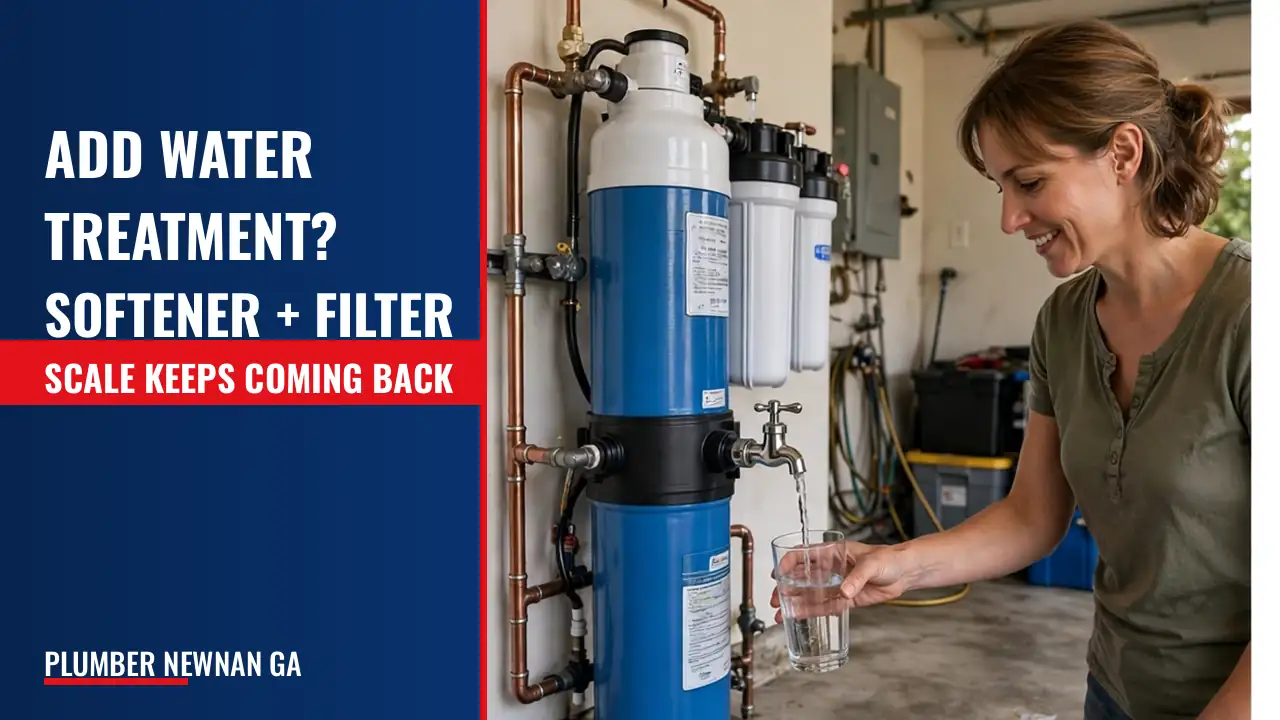
Water treatment is any system that changes the chemistry or cleanliness of the water entering your plumbing. A water softener is an ion-exchange tank that swaps calcium and magnesium for sodium or potassium, which stops those minerals from depositing as scale inside pipes and heaters. A water filtration system passes water through a cartridge or media bed that traps sediment, chlorine, or other contaminants but leaves the hardness minerals in place.
The two solve different problems. Hard water leaves white crust on fixtures and builds scale in a water heater, reducing its efficiency and shortening its life. Filtration improves taste and removes particles but does nothing for hardness. Some homes need both, and some need neither.
Water quality varies by source, so the only reliable way to know what you have is a test of your own water. A softener is the standard fix for hardness; filtration is the standard fix for sediment or taste issues. Choosing one without testing often means paying for a system that does not address the failure you are seeing.
Why Do Scale Failures Keep Happening?
Recurring scale failures usually mean hardness minerals are still entering the system and depositing on hot surfaces. Scale forms fastest where water is heated, so water heaters, tankless heat exchangers, and faucet aerators are the first places it shows. A water heater that scales up loses efficiency and can fail early; a tankless unit can clog its heat exchanger and stop heating reliably.
Scale also narrows pipes and reduces flow over time, which stresses fixtures and appliances. If you have replaced a water heater or cleared scale from a tankless unit more than once, the cause is likely the water, not the equipment. A softener removes the minerals before they reach the heater, which is why it addresses the root cause rather than the symptom.
Not every failure is scale. Sediment can clog aerators and filters, and corrosive water can pit pipes. That is why a test matters: it separates hardness from other water-quality problems and tells you whether a softener, a filter, or both is the right treatment.
What Changes the Answer?
The answer changes with your water source, the age and type of your plumbing, and what has already failed. Homes on private wells often have both hardness and sediment, so filtration plus softening is common. Homes on a municipal supply may have softer water but still see chlorine taste or occasional sediment, where filtration alone may be enough.
The type of water heater matters too. Tankless heaters are more sensitive to scale because their heat exchangers are narrow and hot; a softener often protects that investment. Older galvanized pipes can release sediment, which a filter captures. Copper and PEX pipes handle hardness differently, but scale still forms on fixtures and heaters regardless of pipe material.
Budget and maintenance also change the answer. A softener needs salt and periodic service; a filter needs cartridge changes. If you will not maintain either, it may not deliver the benefit. A plumber can test your water and inspect the failures to recommend the treatment that fits your home rather than a generic package.
What Can You Do Yourself, and What Should You Avoid?
You can test your water with a home hardness kit or a lab sample, and you can record where scale appears and what has failed. You can also check the softener salt level and clean faucet aerators. These steps give you evidence before you spend money on treatment.
Do not install a softener or filtration system yourself unless you are comfortable with plumbing connections and local code. A softener needs a drain, a power source, and a bypass valve; a filter needs a housing that matches your pipe size. Mistakes can cause leaks or bypass the treatment entirely. For anything beyond a simple under-sink filter, a licensed plumber should make the connection.
Avoid choosing a system based on a neighbor’s recommendation or a door-to-door pitch without testing your own water. Also avoid treating hardness with a filter alone, which will not remove the minerals. If you already have a softener that is not working, water softener repair may be the right first step before replacing it.
When Does It Become a Job for a Professional?
It becomes a professional job when you need a system installed, when a softener or filter is failing, or when scale has already damaged a water heater or tankless unit.
Water heater installation and repair also belong with a professional, especially for gas units or tankless systems where scale has caused a failure. A plumber can also perform plumbing repair on fixtures and pipes affected by scale. If you are unsure whether treatment is worth it, a professional assessment gives you a clear answer based on your water and your equipment.
For a broader look at how local water quality affects treatment choices, see a water-quality page connecting regional hardness to softener, filtration, and scale-related failures.
Common Questions About Water Treatment for Hardness and Scale
Here are answers to the questions homeowners ask most about whether to add a softener or filter.
Do I need a water softener if I have a tankless water heater?
It depends on your water hardness. Tankless heaters are more sensitive to scale because their heat exchangers are narrow and hot, so a softener can protect the unit if your water is hard. Test first; not every home needs one.
Can a filter fix hard water?
No. A standard filter removes sediment or chlorine but leaves the calcium and magnesium that cause hardness. Only a water softener removes those minerals, so a filter alone will not stop scale.
How do I know if I have hard water?
Look for white crust on faucets, spots on dishes, and repeated scale in your water heater. A simple hardness test confirms it. If you see these signs and have had scale-related failures, treatment is worth considering.
Should I repair or replace my existing softener?
Repair is often the right first step if the unit is otherwise sound and the problem is a valve, salt bridge, or resin issue. Replacement makes sense when the tank or control head is failing. A plumber can diagnose which applies.