
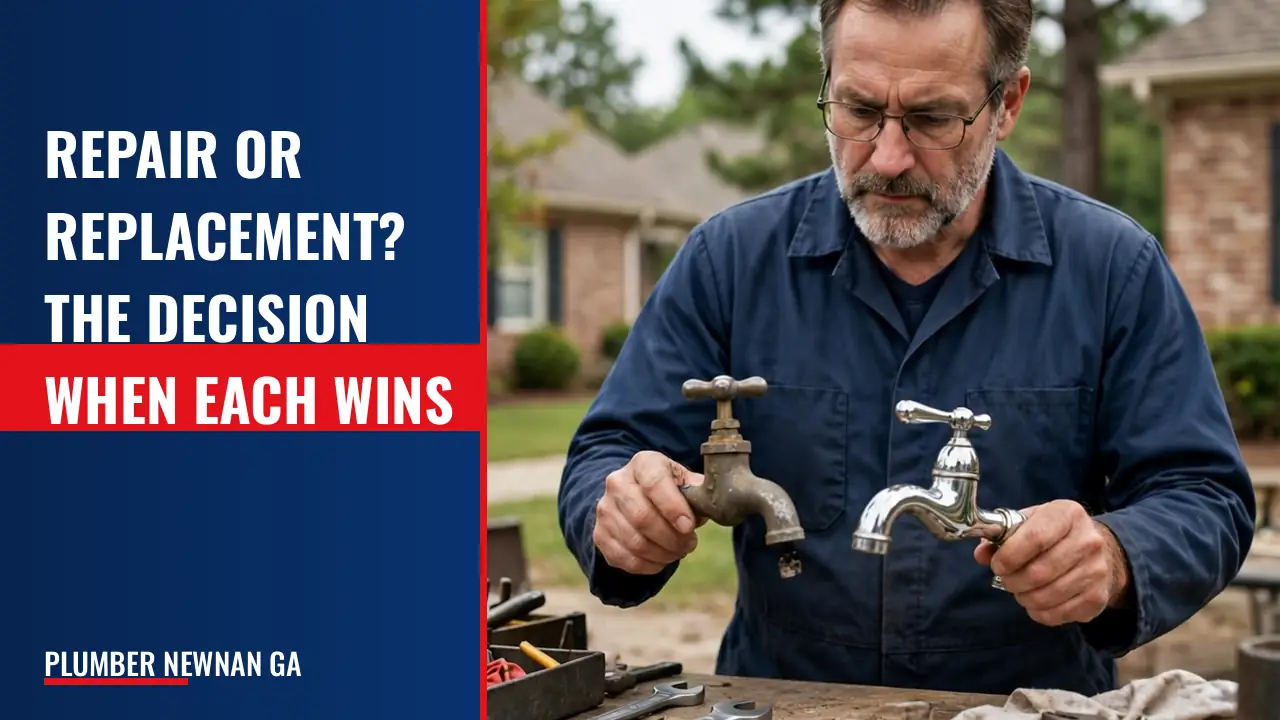
What the repair-versus-replace decision actually is
The repair-versus-replacement decision is a comparison of what it costs to keep a plumbing component working against what it costs to install a new one, weighed against its remaining lifespan and the risk of a second failure. You need it when a part has failed, is failing repeatedly, or is old enough that the next repair buys little time, and you can find more on our blog.
The decision is not about the size of one bill.
How does the repair-versus-replacement decision work?
The decision works by putting four things side by side: the age of the component against its expected service life, the cost of the repair against the cost of a new installation, the warranty each option carries, and the chance the same part fails again soon. A component near the end of its life with a repair bill that is a large share of a new installation usually points to replacement.
Plumbing systems fail in two ways. Some failures are local, such as a worn faucet cartridge or a cracked toilet fill valve, and a repair restores full service. Others are systemic, such as a water heater tank that has rusted through or a sewer line that has collapsed in several places, and a repair only postpones the next failure. The decision hinges on which kind you are looking at, and our bathroom plumbing services cover both.
A licensed plumber reaches that answer with evidence, not guesswork. A camera inspection shows where a sewer line has cracked, bellied or been invaded by roots. Leak detection narrows a hidden leak to a section of pipe. Those findings are what separate a repair that holds from one that fails again in a season.
What changes the answer for water heaters, pipes, drains and sewer lines?
The answer changes with the asset. A tank water heater, a copper pipe, a drain and a sewer line each wear on a different clock and fail in different ways, so the same repair-to-replace ratio does not apply to all of them; see our guide to repair-versus-replace trade-offs.
A tank water heater usually lasts around a decade, though water chemistry and maintenance move that. A leaking tank is almost always a replacement, because the steel has corroded from the inside and patching the outside does not restore it. A failed heating element or thermostat on a tank that is otherwise sound is a repair. A tankless water heater has a longer expected life and is more often worth repairing, since descaling and part replacement keep it running.
Pipes depend on material and location. A single pinhole leak in copper can be repaired, but repeated pinholes along the same run suggest the pipe is failing throughout and repiping is the durable answer. A slab leak may be repaired at the break or bypassed with a new line, depending on access and how much pipe is affected.
What should I know about the cost and warranty trade-offs?
A repair is cheaper today, but a replacement resets the clock and usually carries a longer warranty, so the cheaper option is not always the lower cost over time. The trade-off is time bought against money spent.
A repair buys the remaining life of the component. If that is a few years, the repair is good value. If it is months, the same money goes toward a replacement you will need anyway. A new installation carries a warranty on both parts and labor, which a repair on an old unit does not extend.
The trade-off also includes disruption. Replacing a water heater or a section of sewer line means a day or more of work and, for a sewer, digging or trenchless methods. A repair is usually quicker. Weigh the inconvenience against how soon the next failure is likely.
What can I safely check myself, and what should I leave alone?
You can safely gather evidence and do simple fixture checks, but anything involving gas, electrical connections, sewer lines or opening a wall is a job for a licensed plumber. Knowing where safe do-it-yourself ends protects both your home and your warranty.
Start with a written record. Note the age of the water heater from its label, the date of the last repair, and whether the problem returns. Check for visible water at the base of the heater, corrosion on fittings, and slow drains that back up in more than one fixture. Those observations help a plumber reach the right answer faster.
Simple fixture work is within reach for many homeowners: replacing a flapper, clearing a hair clog with a plunger, or tightening a loose faucet handle. A toilet replacement or toilet bowl replacement is a larger job that belongs with a plumber if the seal, flange or supply line is involved.
The decision becomes a professional job when the failure involves gas, electrical work, a sewer line, a hidden leak, or a repair you have already attempted once. At that point the question is not only repair or replace but what is actually failing, and that takes diagnostic tools, so get in touch with us.
A licensed plumber can run a camera through a sewer line, use leak detection to locate a hidden break, and test a water heater's components. Those findings are the evidence the decision rests on. Guessing at a sewer line or a slab leak often leads to digging in the wrong place or replacing a part that was not the problem.
Some work is legally restricted. Gas line work and the electrical side of a water heater require a licensed trade. Sewer and drain work below the slab or under a yard needs permits in most jurisdictions. A plumber who holds a master licence and insurance carries the responsibility for that work.
What mistakes should I avoid?
The most common mistake is choosing the cheaper repair without asking how much life is left in the component. A second mistake is replacing a whole system when one part failed, which spends money the problem did not require.
Avoid patching a leak you cannot see the cause of. Avoid ignoring a slow drain that backs up in several fixtures, which often signals a main line problem rather than a local clog. Avoid choosing a replacement on price alone without comparing the warranty and the work it covers.
Finally, avoid treating a repair as permanent. A repair restores function; it does not reset the age of the component. Keep the record so the next decision is easier.
What Is Repair Versus Replacement Decision And When Do You Need It: Questions Answered
Here are the questions homeowners ask most about this decision.
What is repair versus replacement decision and when do you need it?
It is the comparison of repairing a failed plumbing component against installing a new one, based on remaining lifespan, cost, warranty and the risk of repeat failure. You need it when a part fails, fails again, or is old enough that a repair buys little time.
How does repair versus replacement decision and when do you need it work?
It works by weighing the age of the component against its expected service life, the repair cost against a new installation, and the warranty each option carries. A local failure on a sound component favors repair; a systemic failure near end of life favors replacement.
What should I know about repair versus replacement decision and when do you need it?
Know that a repair buys the remaining life of the component, so a cheap repair on an old unit can cost more over time than a replacement. A new installation resets the clock and carries a parts and labor warranty, which a repair does not extend.
When does repair versus replacement decision and do you need it matter?
It matters most when a water heater tank leaks, a pipe leaks repeatedly, or a sewer line clogs again after clearing. Those are the moments when the choice between repair and replacement changes what you spend and how soon the problem returns.