
Quick Answer
Replace the component when it is at end of life, meaning it is past its expected service span and has already failed more than once, because the durable fix usually costs less over a few years than repeated repairs. Repair is the right call when the part is young, the failure is a single known cause, and the rest of the system is sound, as our blog explains.
The decision turns on age, failure history, the condition of what surrounds the part, and what a replacement actually includes.
What does end of life mean for a plumbing component?
End of life means the component has reached the point where its remaining service life is shorter than the repair you are about to pay for. A fixture, pipe section, valve or water heater is at end of life when it is near or past its expected span, when the same fault keeps returning, or when the material itself is degrading rather than just blocked or worn at one point. If you are unsure, get in touch with us.
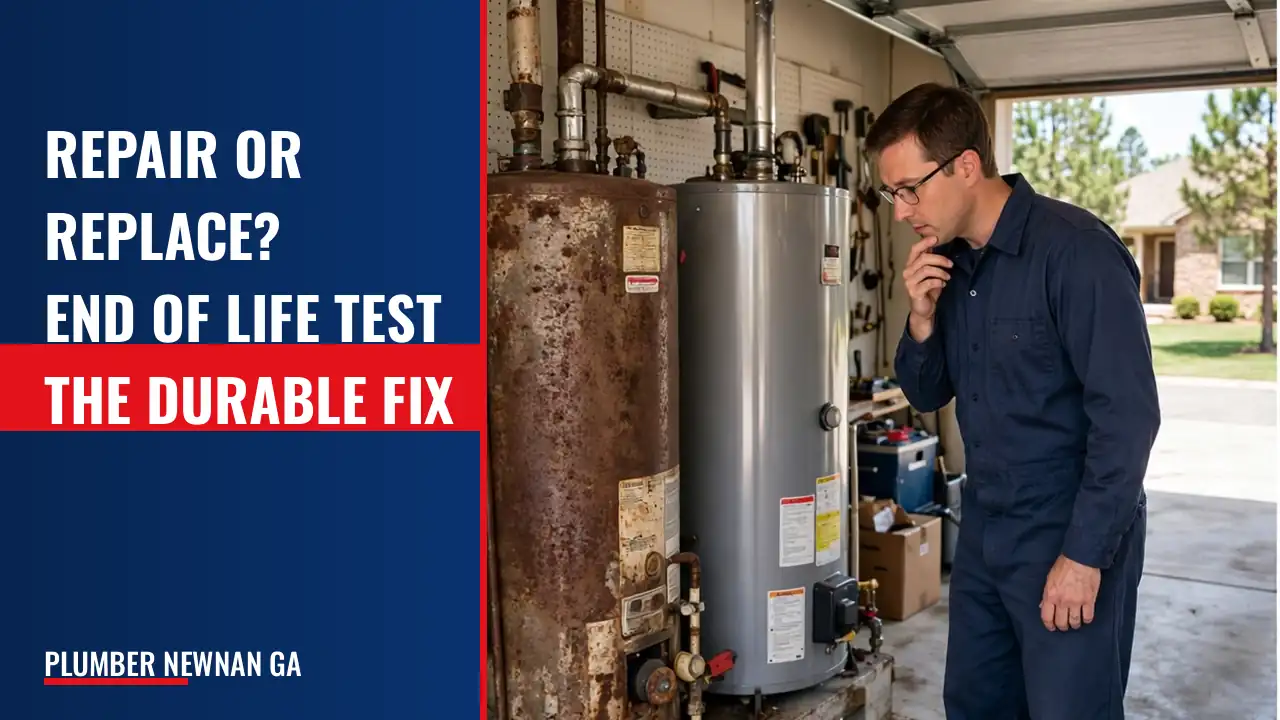
Plumbing components fail in two different ways. A single-cause failure, such as a worn flapper in a toilet or a clogged drain, is repaired and then runs normally again. A system-wide failure, such as a corroded tank or a pipe that has thinned along its length, keeps producing new leaks because the material is spent. That second pattern is what makes a repair a bandaid rather than a fix, and it is why bathroom plumbing work often turns into replacement.
Age alone does not decide it. A ten-year-old water heater that has never leaked may still have years left, while a younger one fed aggressive water can fail early. The useful test is whether the part has failed before and whether the surrounding parts are the same age.
Why does repeated repair cost more than one durable replacement?
Repeated repair costs more than one durable replacement because each repair carries its own labour, its own parts and its own risk of a second failure, and those add up faster than a single replacement. The durable fix also resets the clock on the part, while a repair only postpones the next failure.
Think about what you pay for each time. A repair bill includes the diagnosis, the access to the part, the part itself and the labour to install it. When the same component fails again, you pay the diagnosis and access a second time. A replacement pays those costs once and includes a new component with a fresh service life.
The math favours replacement when the repair is a large share of the replacement cost, or when the part is old enough that a second failure is likely within a year or two. It favours repair when the part is young and the fault is isolated. A toilet that needs a new fill valve is a repair. A toilet whose bowl is cracked and whose tank is also leaking is closer to toilet bowl replacement, which is why the choice belongs with the whole fixture.
What changes the answer for water heaters, drains, pipes and sewer lines?
The answer changes with the type of component because each one has a different expected life, a different failure pattern and a different cost of access. A tank water heater, a drain line, a supply pipe and a sewer line are not judged by the same rules.
A tank water heater usually gives a clear signal: a leaking tank means the steel has corroded through and cannot be repaired, so replacement is the durable fix. A tankless water heater has a longer service life and is often repairable through descaling and part replacement. Drains and sewer lines are different again, because the pipe may be sound while the blockage is a one-time clog, or the pipe may be cracked and collapsing. A camera inspection shows which one you have, and that evidence is what separates a cleaning from a repair or a replacement.
For pipes, the deciding factor is often how much of the run is affected. One pinhole leak in copper is a repair. Several leaks along the same run point to a repipe of that section. The same logic applies to a sewer line: a single root intrusion can be cleared, while a line that has repeatedly backed up and shows offset joints is a candidate for replacement.
What is included in the price of the durable fix?
The price of a durable fix includes the new component, the labour to remove the old one and install the new one, the materials needed to connect it, disposal of the old part, and any testing or inspection that proves the work is sound. It should also state what is not included, such as drywall repair or permit fees where those apply.
A fair price is built from those parts, not from a single number. Ask what the part is, what brand and model, whether the old one is hauled away, and whether the work is tested before the plumber leaves. For a water heater, the price should say whether a new expansion tank, pan or shutoff valve is included, because those parts are often needed and are sometimes left out of a low figure.
The same applies to a toilet or a faucet. A toilet replacement price should cover the new fixture, the wax ring and supply line, the removal of the old toilet and a test flush. A price that leaves out the wax ring or the disposal is not the full cost. The durable fix is worth the money when it includes everything needed for the part to run its full service life.
How can I keep the cost of the durable fix down?
You keep the cost down by catching the failure early, choosing the right moment to replace rather than waiting for a flood, and maintaining the parts that respond to maintenance. A planned replacement costs less than an emergency one because it avoids water damage and after-hours work.
Maintenance is the cheapest lever. Flushing a tank water heater removes sediment that shortens tank life. Descaling a tankless unit protects the heat exchanger. Keeping drains clear of grease and wipes reduces the chance of a sewer backup that turns a cleaning into a repair. These tasks do not replace worn parts, but they let a sound part reach its expected life, as covered in our guide to repair-versus-replace trade-offs.
The other lever is scope. Replacing one failed section of pipe is cheaper than repiping the whole house, but only if the rest of the pipe is sound. Ask for evidence before agreeing to the larger job. A camera inspection of a drain or sewer line, or a leak-detection report for a hidden pipe, shows what is actually failing and keeps the work to what is needed.
When should I stop repairing and replace instead?
Stop repairing and replace when the part has failed more than once in a short period, when it is past its expected service life, or when the repair cost approaches the replacement cost. Those three conditions together mean the next repair is likely to be followed by another.
A practical checklist helps. Replace if the component has leaked or failed twice within a few years, if the repair price is a large share of a new installation, if the part is old and its material is degrading, or if a professional inspection shows the surrounding system is also worn. Repair if the failure is a single known cause, the part is young, and the rest of the system is sound.
The decision is not always obvious, and it is reasonable to ask for the reasoning in writing. A plumber who shows you the failed part, explains what a repair would and would not fix, and states the expected life of each option is giving you what you need to choose. Where the choice involves gas, sewer lines or hidden pipe, the work itself belongs with a licensed professional.
Repair Versus Replace: Is The Failed Component At End Of Life, And What Does The Durable Fix Cost Against Repeated Repairs: Questions Answered
Here are the questions readers ask most about repair versus replacement, answered plainly.
Repair versus replace: is the failed component at end of life, and what does the durable fix cost against repeated repairs?
Replace when the component is at end of life, because the durable fix usually costs less over a few years than repeated repairs. Repair when the part is young and the failure has a single known cause. The comparison is between the full replacement price and the sum of repair bills plus the risk of water damage.
What is included in the price of repair versus replace: is failed component at end of life, and does durable fix cost against repeated?
The price includes the new part, labour to remove and install it, connection materials, disposal of the old part, and testing. A complete price also states what is excluded, such as drywall repair or permit fees. Ask for those exclusions before you compare two figures.
What is a fair price for repair versus replace: is failed component at end of life, and does durable fix cost against repeated?
A fair price is one built from the part, the labour, the materials and the testing, with the exclusions stated. It should not be the lowest number if that number leaves out the wax ring, the expansion tank or the haul-away. Fairness shows in what the price covers, not only in its size.
How can I keep the cost of repair versus replace: is failed component at end of life, and what does durable fix cost against repeated down?
Catch the failure early, maintain the parts that respond to maintenance, and ask for evidence before agreeing to a larger job. Flushing a tank water heater, descaling a tankless unit and keeping drains clear let sound parts reach their expected life. A camera inspection keeps a repair to the section that is actually failing.